

Pre-painted aluminium coils (PPAL) are widely used in building facades, roofing panels, and exterior wall cladding. When exporting to Europe and the Middle East, manufacturers must meet strict technical, aesthetic, and regulatory requirements. These regions demand high durability, weather resistance, and consistent appearance for long-term outdoor applications.
This guide summarizes key standards, testing requirements, and compliance considerations for exporting pre-painted aluminium coils to Europe and the Middle East.
Standards for the European Market
For exports to the European Union and other countries adopting EU/CEN standards, the following standards are essential:
| Standard | Coverage | Key Requirements for PPAL |
|---|---|---|
| EN 1396:2015 | Technical specifications for coil-coated aluminium/aluminium alloy sheet and strip (cold-rolled → coil coated or cut-to-length) | Compliance with EN 573-3 (chemical composition), EN 515 (temper), dimensional tolerances, flatness, coating thickness, color deviation, gloss, adhesion, salt spray resistance, weathering, and bend/coil cracking tests. |
| EN 13523 Series | Defines performance testing methods for coated metals | Measures coating thickness, gloss, color difference (instrumental/visual), pencil hardness, adhesion, T-bend cracking, salt spray resistance, UV/humidity aging, and long-term weathering. Compliance is often required by European clients as part of purchase agreements. |
|
EN 485-1 EN 485-4 |
Aluminium and aluminium alloy sheet / strip
|
Provides reference dimensions and tolerances cited in EN 1396. |
| EN 573-3 | Chemical composition of aluminium and aluminium alloys | pecifies maximum and minimum content for elements such as Fe, Si, Cu, Mn, ensuring mechanical performance and coating compatibility. |
| EN 515 | Temper designations for wrought aluminium and alloys | Defines the hardness and processing state (O, H14, H24, etc.), affecting forming, bending, and stretching performance. |
Standards for the Middle East Market
While the Middle East does not have a fully unified standards system, countries such as Saudi Arabia, the UAE, and other GCC states follow specific regulations and often adopt international or regional standards. Key considerations include:
| Country / Region | Standard | PPAL Export Requirements |
|---|---|---|
| Saudi Arabia | SASO / SQM |
|
| UAE | ESMA & Local Building Codes |
|
| GCC Market Practices | - |
Clients expect conformity to recognized standards for: Color matching (RAL or similar), coating thickness, weather resistance, adhesion, bend or crack resistance, aluminium alloy grade and temper, and reflectivity requirements. |
Technical and Performance Indicators
When selecting PPAL for export, clients often review:
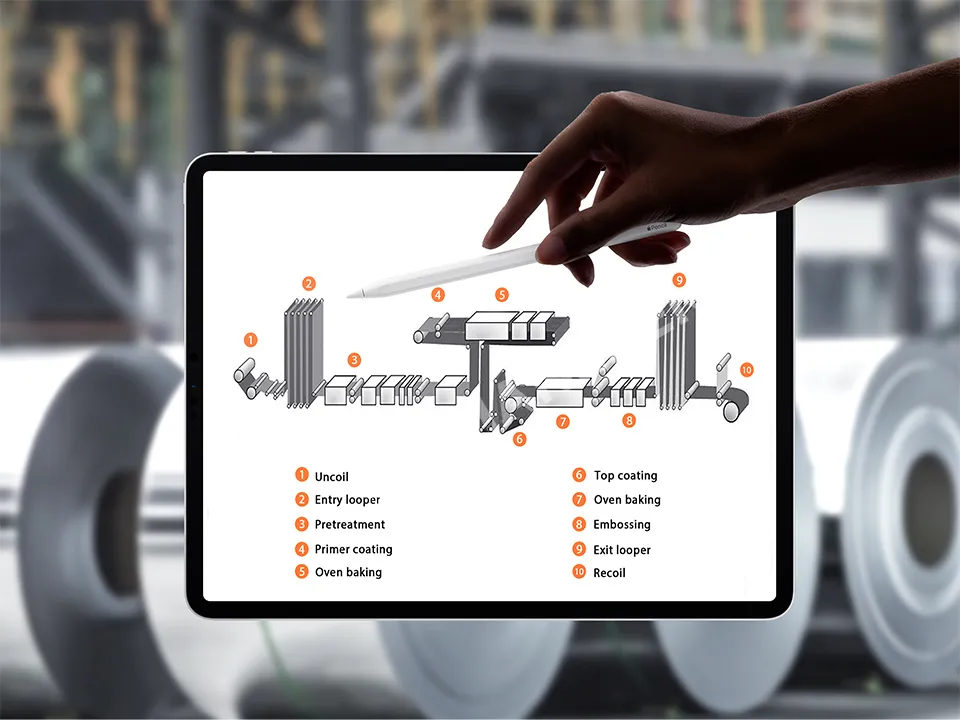
Coating Type & Structure
PE / HDPE: Standard polyester coatings, often in primer and topcoat.
PVDF: Recommended for long-term outdoor exposure due to superior weather and UV resistance.
Dry Film Thickness
Topcoat + primer thickness must meet contract specifications (PVDF: 25 µm topcoat + 5 µm primer).
In Middle Eastern climates, thicker coatings improve UV and heat resistance.
Weather Resistance & Color Stability
Includes UV testing and humidity cycling.
Color difference ΔE and gloss retention are measured; outdoor exposure performance must remain within contractual limits.
Adhesion, Bend & Crack Resistance
Per EN 13523 tests, sheets must withstand forming and bending without peeling or cracking.
Corrosion Resistance
Salt spray tests simulate coastal places.
In desert regions, acid rain, dust, and sand abrasion should also be considered.
Dimensions & Tempers
Thickness, width, length, flatness, edge straightness, and temper (O, H14, H24) must meet specifications.
What preparations has Hanchen made?
To ensure successful export and market acceptance:
- Maintain a compliance matrix aligning internal specifications (alloy, temper, coating type/thickness, tolerances) with customer-preferred standards (EN, ASTM, SASO).
- Conduct EN 13523 series tests for adhesion, bend/crack resistance, salt spray, UV, and humidity aging.
- Keep official test reports for export documentation.
- Obtain ISO 9001, ISO 14001, and mandatory local approvals (SASO/SQM in KSA, ESMA in UAE).
- Clearly indicate standard numbers, alloy, temper, thickness/width, tolerances, batch number, and origin.
- Package to withstand high temperature, humidity, and sand during shipping.
- Define acceptance criteria, testing methods, responsibility for shipping damage, and after-sales guarantees for coating durability and color retention.