

When sourcing color-coated aluminum coil for architecture, façades, roofing, or interior paneling, buyers often focus on alloy grade, coil width, and surface finish, but may overlook a critical factor: the coating process itself, especially whether the coil went through multiple baking cycles.
A multi-bake coating process is not a redundant manufacturing detail. Rather, it is fundamental for delivering high-quality coated aluminium that meets the demands for adhesion, durability, consistent appearance, and long-term performance. This article explains why coating systems use multiple baking cycles during aluminum coil coating, and what it means for customers who rely on coated aluminum for demanding applications.
How a Typical Coil Coating Line Works
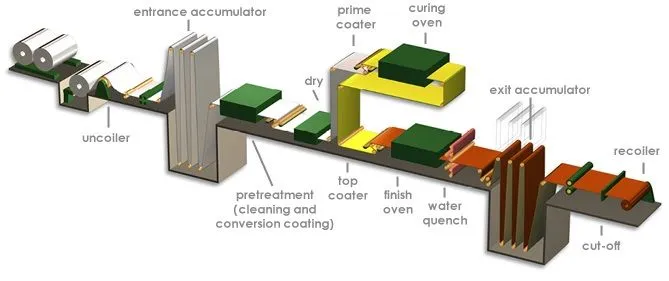
Before diving into the reasons behind multiple bakes, it helps to understand the general workflow of an aluminum coil coating line:
Pretreatment of the aluminum substrate
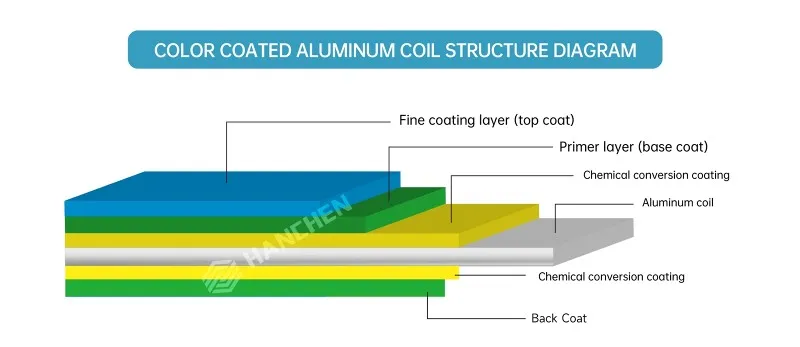
Incoming aluminum coil is first cleaned, degreased, rinsed, and chemically or mechanically pretreated to ensure a clean, oxide- and contamination-free surface. Proper pretreatment is essential to guarantee good coating adhesion and corrosion protection. A thin primer or base layer is applied to enhance adhesion between the aluminum substrate and subsequent coating layers, and to improve corrosion resistance.
First baking (curing) cycle
The base coat (or primer) is cured in an oven under controlled temperature and time. This step establishes a strong, stable bond between the aluminum and the coating base layer. After the primer/base coat is cured, a top coat is applied, typically decorative and functional (PE, HDP, PVDF, or other protective coatings, depending on the required performance).
Second (or final) baking cycle
The top coat is cured separately. This final bake ensures the coating achieves its designed hardness, adhesion, weather resistance, and visual finish. The coated coil is cooled, inspected for coating defects, measured for thickness/uniformity, and then recoiled for packing and delivery.
This "multi-layer, multi-bake" (or two-coat, two-bake) strategy is widely used in coil coating lines worldwide, especially for high-specification architectural color-coated aluminum coil.
Why Multiple Baking Cycles Are Critical, Key Technical Reasons
Guaranteeing Strong Bonding and Adhesion
The first bake ensures the primer/base coat bonds securely to the aluminum substrate. Without a properly cured base layer, adhesion may be weak, causing peeling or delamination, especially after bending, forming, or exposure to moisture.
Ensuring Coating Uniformity, Thickness Control and Surface Quality
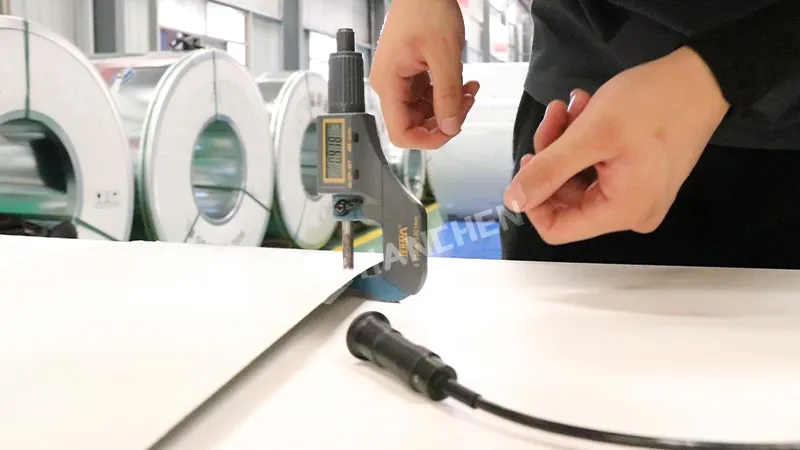
By curing layers separately, the coating line ensures consistent thickness and uniform coverage over the entire coil length. This avoids problems like runs, sags, orange-peel texture, gloss variation or uneven color, issues that often arise when multiple layers are baked at once or not cured properly.
Enhancing Durability, Weather Resistance and Long-Term Performance
The second baking cycle cures the top coat fully, resulting in a hard, durable, stable film capable of resisting UV radiation, chemical exposure, temperature variation, and mechanical stress.
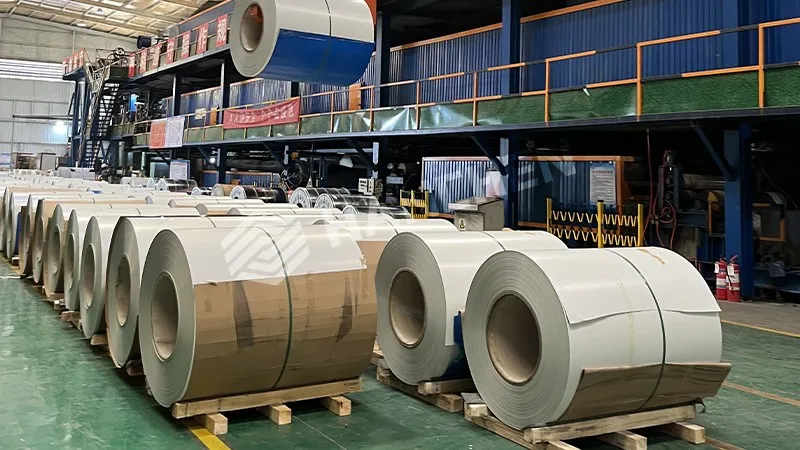
Ensuring Process Stability and Quality Control in Continuous Production
Coil coating is a continuous, high-speed process. Multi-bake design allows stable, controlled curing for each layer, regardless of coil length. It helps maintain consistent temperatures, curing times, coating thickness, and quality across long runs.
They are an essential aspect of producing high-performance color-coated aluminum coil. By curing each coating layer separately and under controlled conditions, manufacturers ensure strong adhesion, uniform coating thickness, excellent surface quality, and long-term durability.
If you are seeking premium-quality color-coated aluminum coil produced through multi-layer, multi-bake coating processes, contact Hanchen Metal today.